

Summary:
Product discovery has gotten a lot harder to map. Customers may move from Google to Shopping to creator reviews to ChatGPT before ever reaching your site. Breaking that journey into four connected layers, owned surfaces, product and data infrastructure, earned signals, and discovery environments, makes it easier to see what is working and what may be holding visibility back.
Think about how many ways someone might discover your product today. They could find it through a Google search, see it in Shopping, watch a YouTube review, come across an influencer using it, read about it in an article, or ask ChatGPT or Gemini for recommendations. There is a good chance they will move between several of those before they ever reach your website.
Your marketing team may have those touchpoints neatly separated into channels, but your customer doesn't see it that way. They are simply researching, comparing options, and deciding what to buy.
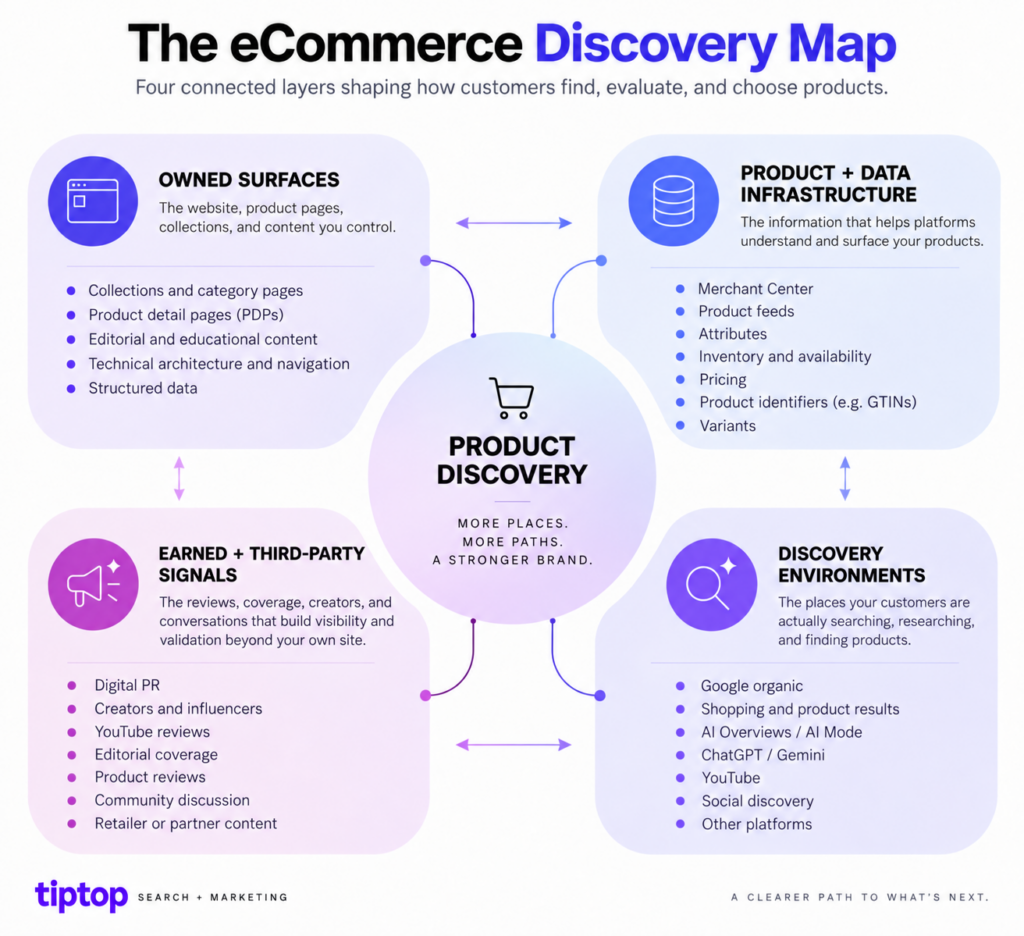
If you want to evaluate your customers’ current journey to your site, break your eCommerce discovery ecosystem into four connected layers:
- Owned surfaces: the website, product pages, collections, and content you control
- Product and data infrastructure: the information that helps platforms understand and surface your products
- Earned and third-party signals: the reviews, coverage, creators, and conversations that build visibility and validation beyond your own site
- Discovery environments: the places your customers are actually searching, researching, and finding products
Looking at these four layers together gives you a better view of where your discovery strategy is strong, where gaps exist, and where one weak layer may be limiting the rest.
Layer 1: Owned surfaces allow you to build a strong foundation for discovery
Your website is the part of your product discovery ecosystem you control most. It is where you decide how products are organized, how categories are structured, what information customers see, and how easily someone can move from research to purchase.
For eCommerce brands, this owned layer includes:
- collection and category pages,
- product detail pages,
- editorial and educational content,
- site architecture and navigation,
- internal linking,
- structured data, and
- the images, video, and messaging that help explain your products.
This layer should make it easy for customers and search systems to understand what you sell, how your products relate to one another, and where someone should go next.
Evaluating this layer means looking beyond whether an individual page is “optimized.” Ask:
- Are our collections built around the way people actually shop?
- Can someone move naturally between related products and categories?
- Do our PDPs answer the questions that matter before purchase?
- Is our product information clear enough that Google and AI systems can confidently understand what each item is and who it is for?
A strong owned foundation gives every other part of the discovery map more to work with. Your feeds are stronger when the underlying product information is clean, PR and creators have clearer stories to tell, and search engines have better information to interpret.
Layer 2: Clear product and data infrastructure helps platforms understand what you sell
While clear product copy on your site helps shoppers understand what you sell, structured product information is also essential for discovery platforms to understand how to categorize, surface, and match products to relevant searches.
For eCommerce brands, product and data infrastructure can include:
- Google Merchant Center,
- product feeds,
- titles and descriptions,
- categories and attributes,
- pricing,
- inventory and availability,
- variants,
- product identifiers like GTINs, and
- images and other assets tied to the feed.
Mastering this information layer means your product catalog can move cleanly from your site to the platforms.
When the data is incomplete, inconsistent, or poorly structured, products can miss opportunities to appear across Shopping and other discovery experiences. A great PDP only goes so far if the feed is missing critical attributes, the product title is vague, or important variants are not represented correctly.
This layer is also where SEO, paid media, and eCommerce operations begin to overlap. Merchant Center may sit with paid, but the information inside it can also support organic product visibility.
Regardless of who owns the system, the product information needs to be accurate, complete, and consistent enough for Google and other discovery platforms to understand what you sell.
Learn more: Google Merchant Center best practices
Layer 3: Earned media and third-party reviews build visibility beyond your own site
You can control what you say about your products on your website, but you have far less control over what the rest of the web says about them.
That is where earned media and third-party visibility makes such a difference and why we strongly recommend investing in a digital PR strategy.
This layer can include:
- editorial coverage,
- product roundups,
- reviews,
- creators and influencers,
- product seeding,
- YouTube reviews,
- community discussion, and
- retailer or partner content.
These third-party channels give customers context and validation beyond the brand’s own claims.
Even if your website is excellent, shoppers will often look elsewhere before they buy. They may search for reviews, watch someone use the product, compare it against another option, look for expert opinions, or ask an AI tool whether the brand is worth considering.
If you are missing from those conversations, your owned content can only carry the story so far.
Search data can help you target these conversations. If people repeatedly search for a certain comparison, use case, or product question, that insight can shape which products you seed, which stories you pitch, which creators you work with, or where you need stronger third-party coverage.
Learn more: How to Measure Your Brand’s AI Visibility
Layer 4: Discovery environments where customers actually find you
This final layer is where the work from the previous layers starts to show up.
Discovery environments can include:
- Google organic,
- Shopping and product results,
- AI Overviews and AI Mode,
- ChatGPT, Gemini, and other AI tools,
- YouTube,
- social platforms,
- and other places customers use to research products and compare options.
The mistake is treating each of these as a completely separate customer journey. In reality, shoppers can move between several of them during the same purchase process.
- A strong collection page may help you rank in Google.
- Clean product data can help your products appear in Shopping.
- Third-party coverage can build customer trust while also giving AI systems more context about your brand.
- A creator video can spark branded search.
- A useful YouTube video can answer a question and finally get someone to the PDP.
This fragmented discovery journey is why channel-by-channel reporting only tells part of the story. Discovery can begin in one place, continue somewhere else, and lead to a purchase much later on your site.
Your owned, product-data, and third-party layers should work together to give you more opportunities to appear across those discovery environments.
The discovery layers are more valuable when they work together
You can have a strong eCommerce program and still leave a lot of discovery on the table if one part of the system is weak.
A few common examples:
- Strong site, weak third-party visibility: Your collections and PDPs are solid, but very little exists outside your site to validate the brand or help customers compare you against other options.
- Strong PR and creator activity, weak product data: You are generating attention, but feeds, attributes, or product information are limiting how consistently those products can appear elsewhere.
- Strong product data, weak owned experience: Your products can get found, but the site makes it difficult to understand the category, compare options, or confidently move toward a purchase.
- Strong content, weak discovery presence: You have useful information, but it isn't reaching the places where customers research and make decisions.
Viewing discovery as a connected system helps you see where the gaps are and where the next meaningful opportunity may be. Improving the right layer can create lift across several parts of the journey at once.
How to use the four layers of eCommerce Discovery
Use the layers to pressure-test each part of your product discovery strategy, rather than evaluating every channel on its own.
Start with four questions:
- Owned: Can customers and search systems clearly understand what you sell, how products relate, and where to go next?
- Product and data infrastructure: Is your product information complete, accurate, and structured well enough to travel across discovery platforms?
- Earned and third-party: Are credible people and publications talking about, reviewing, comparing, and validating your products?
- Discovery environments: Are you showing up in the places customers use to research and find products?
You will often find that one or two areas do most of the heavy lifting while another creates drag.
Every layer will rarely be perfect at the same time. Find the biggest gap, understand how it is affecting the rest of your discovery ecosystem, and focus your resources there first.
Find the weak point in your product discovery
The biggest opportunity may be sitting in a part of the journey you have not been looking at closely enough.
If you want help finding it, tiptop can map your full discovery ecosystem, identify the gaps, and build the right SEO, GEO, content, and digital PR priorities around them.
You might also like: