

Summary:
As product discovery expands into AI agents and syndicated shopping platforms, strong creative and polished PDPs are no longer enough on their own. Clean, structured product data helps platforms accurately understand, categorize, and recommend products, making data quality an increasingly important part of eCommerce visibility.
Note: This guide is primarily geared towards brands operating on Shopify; however, the core principles apply to almost any e-commerce brand. Methods of execution will vary depending on e-commerce platform, and many platforms do not syndicate product data to AI tools & LLMs the way that Shopify does.
Product data is not an exciting topic for most marketers, who would much rather spend their time on compelling product visuals and innovative creative campaigns.
Generally, data entry is handled by completely separate teams that often need to manage large product catalogs and meet tight deadlines. For these teams, their primary concern is usually getting a product live on time, not filling out every data field and tracking down specs.
This model is increasingly not feasible, as AI agents and syndicated shopping platforms have very different requirements for success, and require marketing and product teams to collaborate much more closely.
Where problems arise
E-commerce product data traditionally breaks down into two main layers:
- Backend operational data: Identifiers used for internal tracking, supply chain logistics, and store organization. These can include:
- IDs
- SKUs
- GTINs
- Tags
- Frontend customer-facing data: Information rendered directly on a Product Detail Page (PDP) to help customers understand a product’s purpose, features and capabilities and drive conversions. These can include:
- Titles
- Descriptions
- Media
- Variant options (size, color, etc)
- Feature bullets
- Technical specs
- Comparison charts
- FAQs
Historically, when this data is added to a brand’s own online storefront, little thought is given to where else it might end up.
However, taking product data originally intended for a single site and syndicating it across modern shopping channels can often reveal significant gaps and issues.
- Formatting mismatches:
- Internal IDs don’t link product variants together.
- Rich plain text product descriptions need to be translated to multiple templated fields.
- Image sizing and formatting doesn’t align with platform requirements
- Contextual data gaps: Implicit details obvious to a human navigating a single brand site are completely missing.
- Product titles don’t contain the brand name
- Product attributes like target gender and age group aren’t accounted for
- Siloed taxonomy: Internal organization logic that makes sense on a custom website doesn’t directly map to external taxonomies
- You only sell backpacks, so you categorize a product as:
- Backpacks > Outdoor Backpacks > Outdoor Laptop Backpacks
- Google & Shopify categorize the same product as:
- Luggage & Bags > Backpacks
- You only sell backpacks, so you categorize a product as:
Why Old Approaches to Product Data No Longer Work
Strategies for organic product discovery have traditionally relied on two key pillars: incorporating relevant keywords on PDPs for search engine crawlers and visual storytelling to convert visitors.
Now that AI agents and other shopping surfaces/platforms rely increasingly on structured data feeds rather than rendering and scraping front-end web pages, stopping at a great on-page experience leaves you at a significant disadvantage.
If product data relies on marketing fluff, lacks machine-readable structure, or hides key attributes in unstructured layout templates, potential customers are less likely to encounter your products and AI tools/LLMs won’t recommend them.
How AI Agents & Human Shoppers Engage With Products Differently
Human shoppers and AI agents evaluate product catalogs very differently.
Human Shoppers
Visually driven: Scans images, reads lifestyle copy, infers context, influenced by previous marketing they have encountered.
AI Agents
Attribute driven: Parses precise parameters, constraints & metadata.
A human browsing an outdoor gear and apparel site can infer from an image that a bag is designed for outdoor hiking even if the product title is simply "The Pathfinder."
An AI agent handling a prompt like "Find a waterproof 40L outdoor backpack with a dedicated laptop compartment under $150" is much more likely to choose a product where all of those data points are clearly laid out, than a product that has great lifestyle imagery.
The New Ecosystem: Syndication to AI Destinations
Product data feeds no longer serve only traditional Google Shopping ads or basic merchant listings. Platforms across the e-commerce landscape now syndicate product feeds directly into agentic AI environments, including ChatGPT, Gemini, Microsoft Copilot, and Meta.
- Google Universal Commerce Protocol (UCP): Launched as an open protocol connecting consumer AI surfaces (such as AI Mode in Google Search and the Gemini app) directly to store backends. UCP standardizes real-time product discovery, cart updates, loyalty linking, and agentic checkout capabilities.
- Shopify Agentic Storefronts & Shopify Catalog: Shopify standardizes merchant inventory into the Shopify Catalog, syndicating structured product data directly into live AI channels like ChatGPT, Copilot, and Gemini. Instead of scraping web pages, AI agents interact directly with structured catalog feeds.
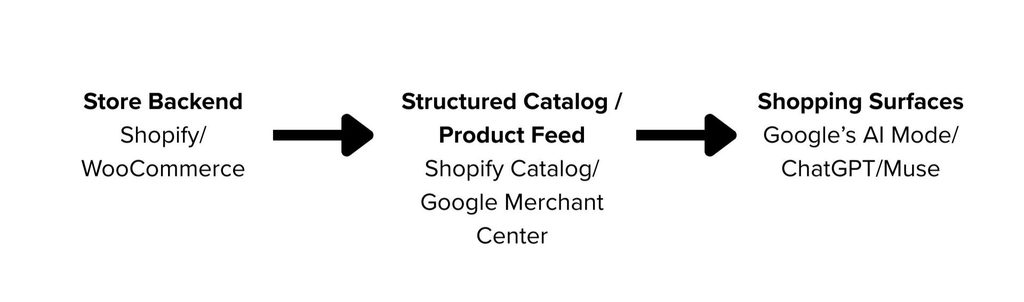
If a store's feed features vague, incomplete titles or unmapped custom attributes, syndicated AI platforms drop those products during query evaluation.
What You Can Do To Level Up Your Shopify Product Data
Assign all products to the closest matching Shopify category
Shopify features a built in product taxonomy that covers in varying degrees of detail most types of products.
You can view the full Shopify category taxonomy here.
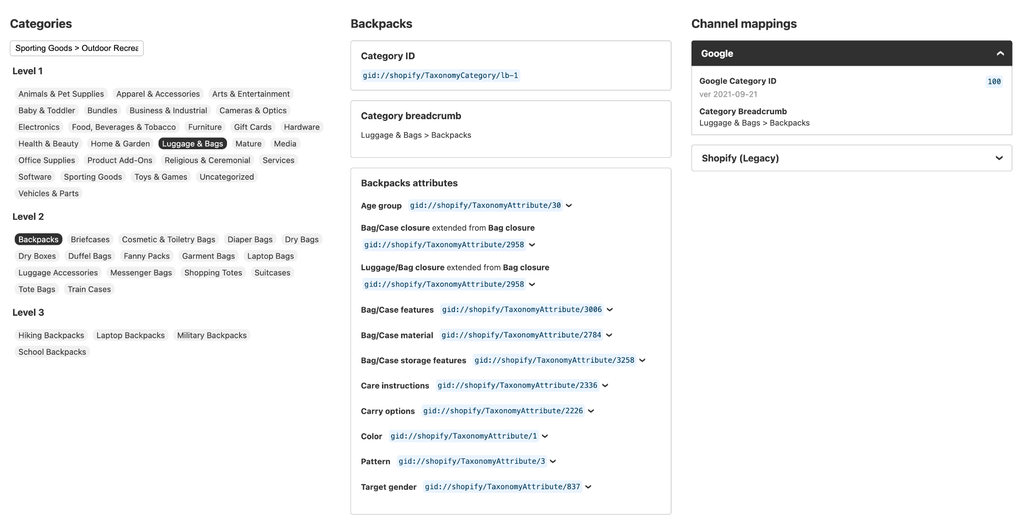
Make sure that all products are assigned to a category and that the assigned category is the best match for the product.

The more specific the category the better. For example, assigning a laptop backpack to “Luggage & Bags > Backpacks” is much more helpful than just “Luggage & Bags”.
Populate all applicable category metafields
Each category also has specific metafields pre-assigned to it to highlight product details unique or useful for that category. While these can be edited, utilizing the default fields is helpful because Shopify has already defined them and knows precisely how to map them.
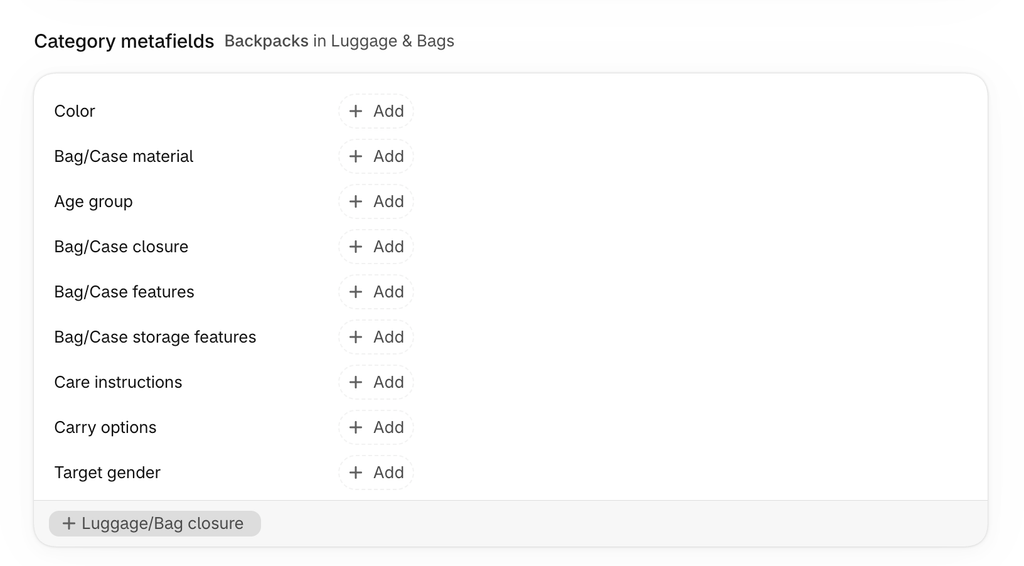
Many Shopify stores rely heavily on custom product metafields to fit their exact needs and ignore the category metafields in the process. While this approach generally gives you much better control over your site’s experience and makes development easier, it’s important to still populate category metafields as much as possible to aid with product discovery.
Depending on how your collection page filters are set up, category metafields can also be used to power your filters to help customers find exactly what they are looking for.
Rewrite Titles and Descriptions for Dual Audiences
Optimize top revenue-generating SKUs by rewriting titles and descriptions for both human shoppers and AI models:
- Include core identifying attributes directly in product titles (e.g., Brand + Gender + Item + Key Material/Feature + Size/Color).
- Ensure product descriptions include clear, verifiable product claims, explicit use cases, and full variant contexts rather than relying solely on emotive marketing language.
You can still use alternate titles on your site, to fit within design constraints and utilize preferred marketing language.
Audit External Shopping Platforms
Review how your products are showing up in platforms like Google Merchant Center and Microsoft Merchant Center.
- Check for formatting issues, warnings, and errors.
- These platforms often want attributes like size or target age group formatted very specifically.
- Look for product data that isn’t making it over.
- Sometimes custom solutions are required to take the data you have on your site and translate it successfully to these platforms in a way that satisfies their limitations.
Check out our guide to Google Merchant Center best practices for more information →
E-commerce brands can’t rely solely on visually appealing storefront designs and clever marketing copy to drive conversions, as product discovery shifts upstream into conversational AI interfaces, shopping agents, and increased reliance on external shopping platforms.
Product data that was more than sufficient five years ago is no longer adequate.
The brands that invest in clean, structured, and deeply detailed product data today will be the ones recommended by AI agents tomorrow. Don't let bad data make your brand invisible.
Do you need help bringing your product catalog up to speed? Let’s talk!