

Summary:
AI search measurement goes beyond referral traffic. Explore how GEO metrics, brand visibility, citations, and attribution help evaluate AI discovery.
A prospect recently filled out a “Talk to an Expert” form on a B2B client’s site. In the message, they mentioned ChatGPT had listed the company second among potential solutions. Without that one sentence in a form field, we’d have had no reliable way to know AI played a role.
That’s the gap in how most brands are measuring AI search right now.
Marketers naturally started with familiar metrics: referral traffic, conversions, and revenue. By those measures, AI search still represents a small share of traffic compared with traditional organic search. That has raised legitimate questions about GEO (Generative Engine Optimization). If AI platforms aren’t sending much traffic, how much should brands invest in being visible there?
It’s a fair question. But AI can influence a purchase without generating an attributable visit, and appearing in an AI response doesn’t automatically create business value. Both realities matter.
Here’s how we’re measuring AI discovery for clients today, what we’re learning, and where the scorecard still needs work.
The AI traffic debate is worth paying attention to
There's been a lot of discussion recently about whether GEO is worth the investment, and some of the research deserves serious attention.
Marie Haynes analyzed 12 months of data across 100 websites and found that ChatGPT generated just 0.62% of the traffic Google organic search delivered. Even when including other AI platforms, that figure only reached 0.73%.
The SEO Works reached a similar conclusion across 95 websites, finding that organic search delivered 39 times more traffic than AI assistants.
Kevin Indig explored another possibility: whether AI recommendations were generating visits that eventually appeared as direct or branded traffic. His research couldn't reliably establish that connection, highlighting just how difficult it is to identify AI's influence through traditional analytics.
These are meaningful findings. Google remains the dominant source of organic traffic and conversions for most businesses, and I don't see that changing overnight. Brands shouldn't abandon proven search strategies to chase AI visibility.
But Mike King raised an important counterpoint: AI search may be functioning as a branding and discovery channel, not simply another source of referral traffic.
Both are right about different things. The traffic data is accurate. The conclusion that AI therefore doesn’t matter goes further than the data does.
AI search can introduce people to brands, help them compare options, answer complex questions, and influence purchasing decisions. Some of those interactions generate website visits. Others may influence decisions that happen days, weeks, or months later.
AI referral traffic tells us what AI platforms directly send to our websites; however, it doesn't tell us everything happening before someone gets there.
The customer journey doesn't always include an AI referral
Here’s the form submission message our client’s VP of marketing shared with us.

On the surface, it’s a clean story. Someone researching a business problem found our client in ChatGPT and reached out. But the details we don’t have matter just as much.
We don't know what the prospect originally asked ChatGPT, which competitors appeared alongside our client, or what the recommendations actually said. We don't know whether they clicked a link in ChatGPT, searched for the company on Google, or navigated directly to the website.
We also don't know whether this inquiry will eventually become a customer.
What we do know is that ChatGPT played a role in the prospect's research and evaluation process. And without that person volunteering the information, we might never have known.
B2B makes this especially hard to trace. Purchasing decisions can involve multiple stakeholders, technical questions, and months of research. AI might introduce a vendor early, help compare options later, or answer questions along the way.
Not every AI interaction generates a referral, and not every recommendation leads to a sale.
This doesn't prove the ROI of GEO, but it does illustrate why referral traffic alone may not capture AI's role in the customer journey.
Measuring AI visibility is useful, but context matters
If AI influences discovery and evaluation, we should understand whether our brands appear in relevant conversations.
That's why we've expanded reporting beyond traffic and conversions.
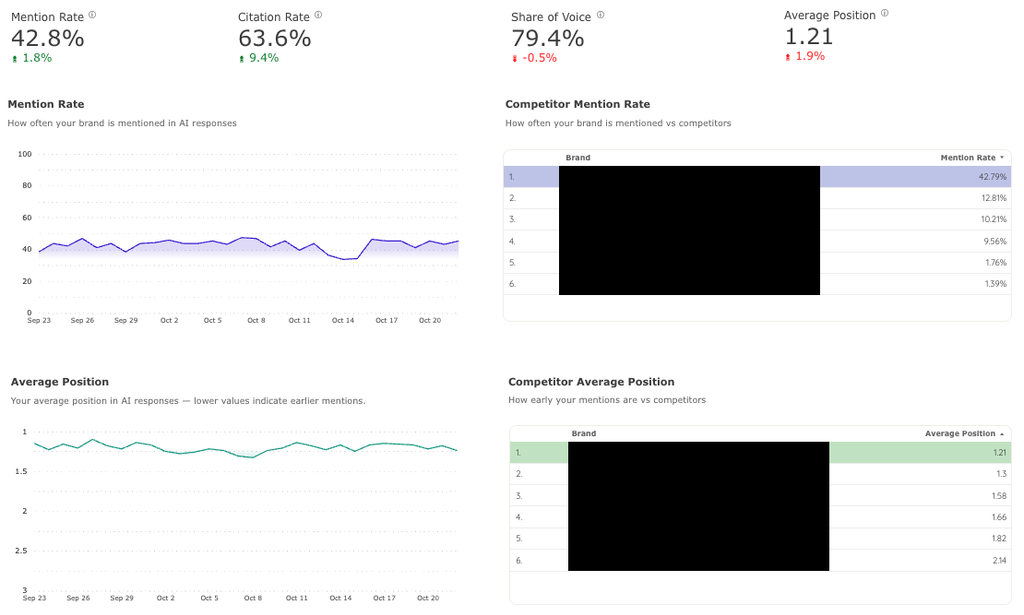
For the brands we work with, we're tracking metrics like mention rate, citation rate, share of voice, and average position across a defined set of prompts. These give us a starting point for understanding how frequently a brand appears in AI-generated responses and how its visibility compares with competitors.
For example, one of our clients currently has a 42.8% mention rate and 79.4% share of voice across the prompts we’re monitoring. Mention rate is the percentage of tracked prompts where the brand appears. Share of voice compares how often the brand appears against the competitors we track across those same prompts, excluding branded queries. So while the brand shows up in fewer than half of the responses, it accounts for nearly 80% of the mentions among its competitive set. That gives us a baseline to evaluate changes in visibility over time.
But these numbers need context.
AI responses can vary between platforms, users, and even repeated searches. The prompts we choose to monitor influence the results, as do the competitors included in our analysis. A high share of voice across one set of questions doesn't mean a brand dominates an entire market.
An appearance isn't always an endorsement. A brand might be cited as a source, listed as an alternative, or mentioned in a comparison favoring a competitor.
That's why we're careful not to treat AI visibility as a direct measure of business performance. These metrics help us understand where a brand shows up, but they don't tell us whether that visibility influences decisions or generates revenue.
Understanding where and why your brand appears
Knowing how frequently a brand appears in AI responses is helpful. Understanding where, why, and in what context it appears makes the information more actionable.
We've been breaking our AI visibility reporting into topical groups that reflect the products, services, problems, and questions relevant to each client's audience.
For one client, we can see strong visibility around commercial questions related to one of their core verticals, while broader informational topics and another key vertical show considerably less visibility.
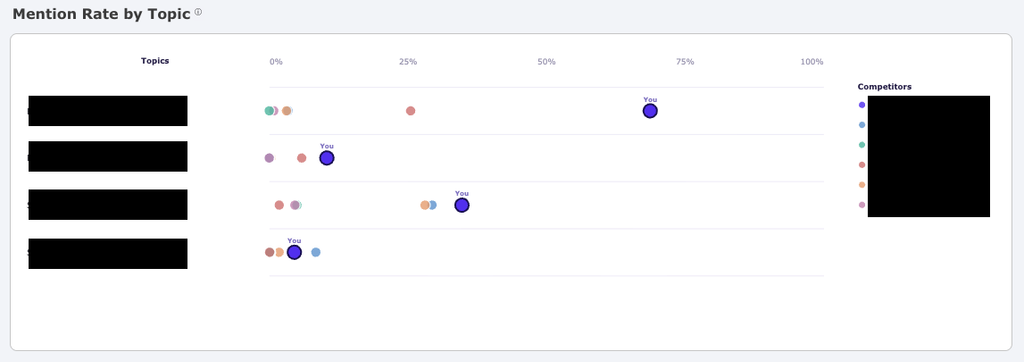
That helps us see where the brand has a strong presence and where its positioning may need work.
From there, we can examine individual prompts. Which questions consistently surface the brand? Where are competitors being recommended instead? And perhaps more importantly, how is the brand being described when it does appear?
Position works differently than it does in a list of blue links. A brand listed third but described as the right fit for the buyer’s situation may be in a stronger spot than the brand listed first.
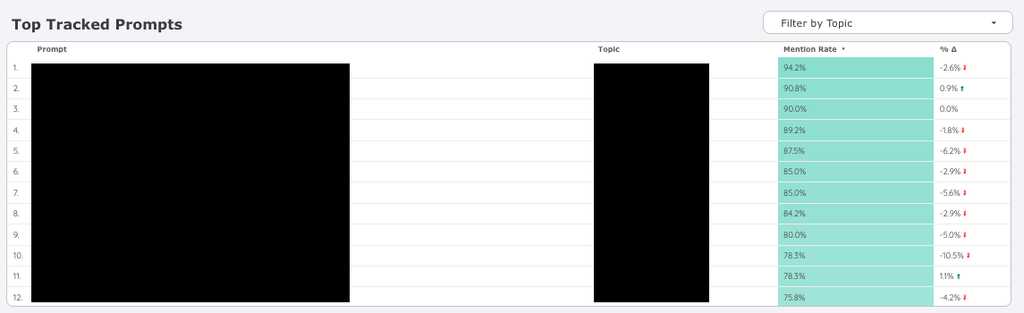
We also examine the sources AI platforms cite: product pages, educational resources, FAQs, and relevant third-party websites. These show what information is being surfaced, though not necessarily what caused the recommendation.
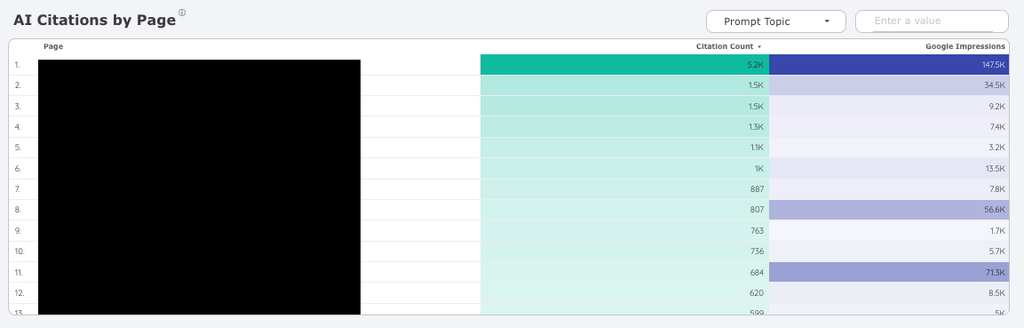
These findings can help guide content improvements, identify gaps in product or service information, strengthen brand positioning, and prioritize opportunities for third-party coverage.
The goal is to help AI systems represent your brand accurately for the questions your customers are asking.
Traffic and revenue still belong on the scorecard
None of this means we should stop measuring traffic, conversions, or revenue from AI platforms.
We track AI referral sessions, their platforms and landing pages, and leads or revenue attributed to those visits. We compare this with traditional organic performance to keep the scale in perspective.
For one client, our reporting shows approximately 297 AI referral sessions and $2,000 in attributed revenue during the measured period. Those are real visits and real revenue, but they're small compared with what organic search generates.
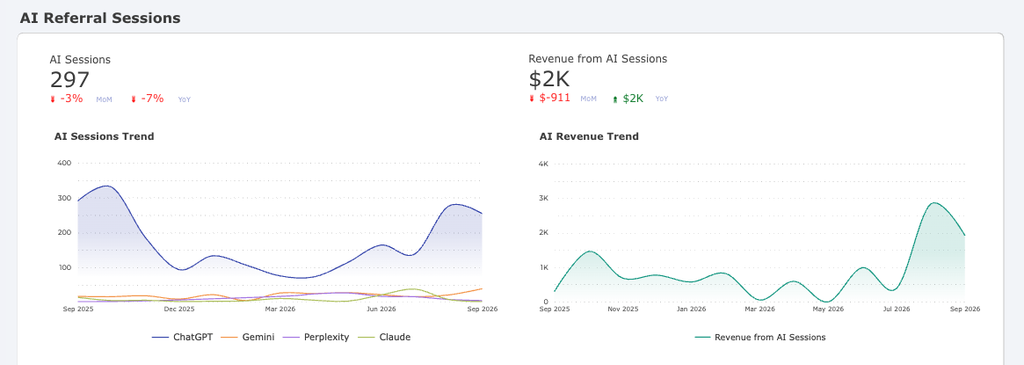
We shouldn't inflate those numbers or pretend they represent something they don't. But we also shouldn't assume they represent the entirety of AI's contribution to the business.
In our reporting, referral traffic and revenue sit alongside visibility, not in place of it.
Looking ahead, AI-powered shopping experiences and agentic commerce could change this picture considerably. As customers find more ways to research, select, and purchase products through AI platforms, opportunities to measure direct commercial outcomes should evolve too.
For now, traffic and revenue remain important measures of performance. But they’re one part of the picture.
A more complete scorecard for AI discovery
If traffic captures only part of the journey, and visibility isn't proof of business impact, how should brands evaluate AI discovery?
We don't think a single metric can answer that question. We're building a more complete picture through five connected areas:
| Measurement | What we're trying to understand |
| Visibility | How frequently does our brand appear in relevant AI responses, and how does that compare with competitors? |
| Relevance & positioning | Are we being associated with the right products, services, audiences, and problems? |
| Sources & authority | What content and third-party sources are being cited, and where can we strengthen the information available about our brand? |
| Buyer influence | What are prospects and customers telling us about AI's role in their research and decisions? |
| Traffic & business outcomes | What identifiable visits, leads, and revenue are coming from AI platforms? |
These measurements aren't interchangeable, and they don't follow a predictable sequence. Someone may encounter a brand through AI long before visiting its website; another might click directly through and purchase. Some interactions may never produce a signal we can reliably measure.
The value comes from combining these measurements and using them to make better decisions.
If a brand has low visibility in an important product category, we can compare its content, positioning, and third-party presence with competitors. If visibility is improving but referral traffic remains flat, that doesn't automatically mean the work is failing or succeeding. We need more context.
Buyer influence is the hardest signal to capture, and often the most telling. A few simple steps help:
- Add “AI assistant (ChatGPT, Gemini, etc.)” as an option in your “How did you hear about us?” field.
- Have sales log AI mentions from discovery calls in the CRM.
- Ask new customers how they researched options during onboarding.
None of this gives perfect attribution, but it captures the parts of the buying journey analytics platforms miss, like the form fill that started this post.
We're still refining the prompts we track, the topics we group, and how these signals relate to broader business performance. The aim is a clear read on where a brand stands, what to fix, and where to invest.
Better measurement leads to better decisions
There's good reason to be skeptical of some claims about GEO. The industry is moving quickly, new tactics seem to appear every week, and the pressure to demonstrate results can lead to some questionable conclusions.
But I don't think the answer is to dismiss AI discovery because referral traffic is small. Nor should we assume that every AI mention represents meaningful influence or business value.
The reality is somewhere in between.
AI is a part of how people research, compare, and choose brands. We can measure some of that activity today, but other parts remain hard to tie to traditional marketing metrics. As the platforms and buying behaviors evolve, our approach to measurement will need to evolve with them.
For brands, the priority should be understanding where they appear, how they're represented, and whether they're part of the conversations their customers are having. Then use those insights, along with traffic, customer feedback, and business performance, to make better decisions.
We don't need to pretend we can attribute every lead or sale to an AI interaction. But we do need a better understanding of the role AI plays in helping customers discover and choose our brands.
That's the scorecard we're working toward.
If you want a clearer read on how AI is shaping discovery for your brand, let's talk.
You might also like: