


Summary:
AI visibility starts with whether search and AI systems clearly understand who your company is, what you do, who you serve, and what makes you different. Clear, consistent positioning across your website and third-party sources creates the foundation for stronger visibility, while vague or conflicting brand signals can limit how accurately your business is surfaced and recommended.
Before you worry about “ranking” in ChatGPT, Gemini, or Claude, there is a more basic question to answer:
Do these systems clearly understand who your company is, what you do, who you serve, and why you are different?
If the answer is vague, inconsistent, or changes drastically depending on which AI you ask, your first worry is not “do we have AI visibility”; it is “how do we get AI to better understand who we are as a business.”
We see this when we run brands through our C.L.A.R.I.T.Y. framework, and a recent LinkedIn post from Kevin Dees at Robojuice (one of our trusted web partners) was a great example of someone going through this exercise in the wild. Kevin used AI to pressure-test how Robojuice is positioned and where the public information may not fully reflect the depth of the business.
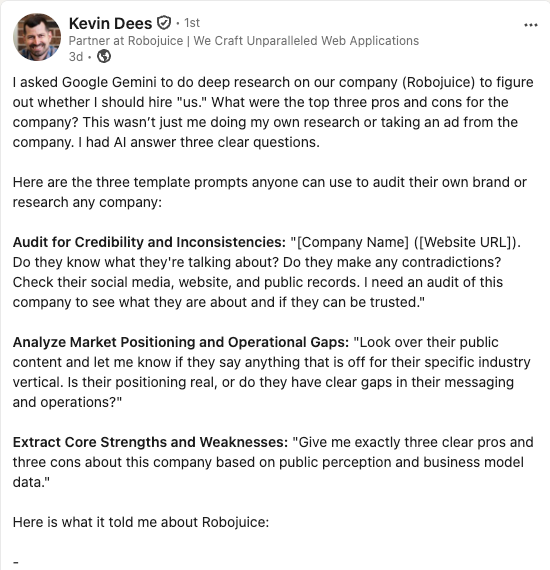
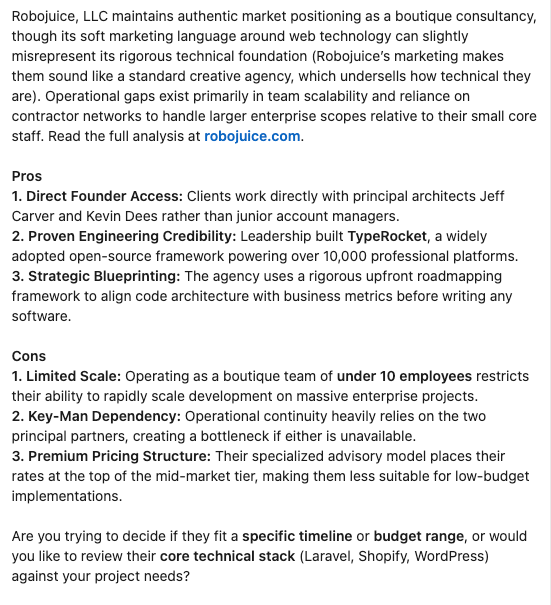
Seeing how others are approaching this, I thought it would be helpful to lay out a simple process for getting started. Not a full AI visibility strategy, just a practical way to understand how AI currently sees your business, where the gaps are, and what you should fix first.
Start with the information you control
When it comes to AI, the temptation is to think you need to jump straight into some advanced optimization tactic. Often, that is not the place to start. Slow down for a moment and look at the information you already control.
Your website. LinkedIn. YouTube. Review platforms. Partner pages. Company bios. Industry profiles. Anywhere you have the ability to explain who you are and what you do.
If that information is unclear or inconsistent, you are starting from a weak foundation before any “AI optimization” strategy begins.
You do not need the exact same copy everywhere, but the core information should be consistent:
- What category are you in?
- What do you actually sell?
- Who is it for?
- What problems do you solve?
- What makes you different?
- Are older products, services, or positioning still hanging around in places you forgot about?
These questions sound basic, but core information is often overlooked. AI is now making those inconsistencies much easier to surface, making it more important than ever to evaluate the pre-existing information on your brand.
We frequently see companies that have put their homepage through multiple rounds of positioning work while their LinkedIn description still reflects the company from five years ago.
Product pages may use one category term, while partner profiles or third-party sites use another. An executive bio may still describe the business the way it looked before a major shift.
On their own, none of those seem like major problems. But together, they create an inconsistent picture of the company, and in many cases, these are places where you have control over the narrative.
Before you try to influence how AI recommends your brand, make sure the information you are already publishing gives it a clear company to understand.
Read more: What Google Wants Isn’t What AI Wants
Generic language gets even weaker when AI summarizes it
Cleaning up inconsistent information is a good start, but consistency alone does not make your positioning strong.
Take a look at the language companies use to describe themselves online and you will see a lot of the same things: innovative solutions, industry-leading expertise, customer-first approach, trusted partner, end-to-end platform. None of those statements are necessarily wrong, but they also do very little to tell someone why one company should stand out from another.
AI has a way of making that painfully obvious.
When an AI system takes information from your website and other sources and compresses it into a short answer, generic language tends to become even more generic. If you and five competitors all describe yourselves with roughly the same attributes, there is not much there to help a system, or a potential customer, understand where you are actually different.
This is where specificity becomes important. Strong positioning gives people and AI something concrete to hold onto:
- the specific audience you serve,
- the category you want to be associated with,
- the problems or use cases you are especially good at solving,
- the attributes that actually separate your product or service, and
- evidence that supports those claims.
You can see the difference pretty quickly when you start testing prompts across multiple AI platforms. If the answer continually reduces your company down to the same generic description it could give three competitors, that is worth paying attention to.
The solution is not stuffing more keywords or brand language into every profile you control. It is making sure there is enough real specificity in the way you describe the business that someone outside your organization can understand what makes it distinct.
Use AI to pressure-test your positioning
Once your own information is in better shape, you can use AI to see how well that positioning is actually coming through.
Start simple. Ask a few different models to explain what your company does, who it serves, what it is known for, and how it is different from competitors. Then compare those answers with how you would want a prospect to describe the business after spending ten minutes on your site.
You are not looking for perfect wording here; at this stage, you’re looking for patterns.
Does one model put you in the wrong category? Does another completely miss an audience that is important to the business? Are your strongest differentiators absent? Does the company sound more generic than you know it is? Are old products, services, or positioning still showing up?
It is also worth running the exercise across multiple models, multiple times. ChatGPT, Gemini, Claude and other AI platforms frequently surface different information from each other, they can also change answers to the same prompts. Knowing this is key, so form a baseline across models with multiple runs using the same prompt. If several systems consistently misunderstand the same part of your business, there is probably something worth digging into.
Instead of simply asking whether you show up, you’re able to see where your positioning is clear, where it is weak, and where the information available online may be telling a different story than the one you think you are telling.
What others say about you matters too
Getting your own information right is the foundation, but it is only part of the picture.
What publications, review sites, partners, customers, creators, industry organizations, and other third parties say about your company can reinforce your positioning — or muddy it further.
This can be more difficult because you do not control every description of your business:
- An old partner page may still frame you around a service you no longer lead with.
- A review platform might place you in a category that is technically correct but too broad.
- Editorial coverage may consistently associate your brand with one part of the business while another area you are trying to grow barely shows up.
On the positive side, strong third-party coverage can help validate the information you are telling about the business. If you say you are known for a certain product, capability, or audience and credible sources independently describe you the same way, that creates a much stronger picture than your website alone making the claim alone.
Digital PR, reviews, partnerships, creator coverage, interviews, podcasts, and other earned visibility are not simply ways to generate another mention or link. They help shape the broader body of information that exists about the company.
You cannot script what every third party says about you, nor should you try. But you can pay attention to the patterns. If the outside world consistently describes your business differently than you describe it yourself, that is something worth understanding before you move into more advanced AI visibility work.
Learn more about Entity Optimization →
Once AI understands you, the harder work starts
Getting AI to accurately understand your business is important, but even clear, consistent story and positioning does not guarantee mean you are going to appear when someone asks questions like:
- What are the best options for this problem?
- What companies should I consider?
- What are the alternatives to a competitor?
- Which products are best for a specific use case?
- What brands are known for a particular attribute?
This stage is where your AI visibility strategy starts to move beyond positioning and into the broader work of building relevance and authority around the topics that matter to your business.
Your own website still plays an important role. Think landing pages built around specific industries and ICPs, supported by content that maps to the problems those audiences are trying to solve.
But your site is only part of the picture. Editorial coverage, reviews, product comparisons, expert commentary, creator content, partnerships, community discussion, and other third-party sources can help strengthen the connection between your brand and the categories or problems you want to be associated with.
That work is harder because you cannot simply rewrite a page and call it finished. You are trying to build a stronger footprint around the business over time and give AI systems more reasons to connect your brand with the right conversations.
This is why I would separate the two problems.
First, make sure AI understands who you are.
Then start working on whether you are visible when your customers ask the questions that could lead them to you.
Get your brand information right before you chase visibility
AI visibility is getting a lot of attention right now, and for good reason. But there is a tendency to jump straight to the harder question of how to get a brand mentioned more often without first asking whether AI has a clear understanding of the brand in the first place.
First, get the fundamentals right. Make sure the information you control is accurate, your positioning is specific, and the broader story around the company is reasonably consistent.
Then move into the harder work: building stronger associations with the categories, problems, products, and conversations where you want the brand to appear.
If AI is giving you a muddy picture of your company today, that is useful information. Before trying to change the answer, figure out what is creating it.
See how AI understands your brand
If you are not sure what picture AI is building of your company, that is exactly the kind of thing we look at through our C.L.A.R.I.T.Y. process.
We can help you establish a baseline, identify where your positioning or brand signals are breaking down, and build a clearer path toward stronger AI visibility.