


Summary:
Many teams hit a point where consistent publishing no longer translates into growing authority. Early wins level off, rankings stall, and new content struggles to gain traction despite a full calendar and steady output. The issue isn’t activity, it’s the absence of a reinforcing system that turns publishing into compounding expertise.
Content calendars create structure and give leadership something concrete to align around. In a discipline like SEO that can feel abstract, a calendar makes content feel operational.
That’s the promise at the beginning: If we plan content and publish regularly, results will follow.
But over time, many teams find themselves in a frustrating place. The calendar is full, the team is busy, and the content is shipping, but authority isn’t building the way they expected. After early success, rankings become stagnant and organic performance plateaus. New posts don’t seem to perform like old ones did.
This is where it helps to separate two ideas that are often treated as the same thing:
- A content calendar as a scheduling tool
- A content calendar as the publishing output of a content system
Following a well-organized calendar is not the same as building authority with a content system.
Don’t get us wrong, we absolutely create content calendars. But under the hood of a publishing schedule, what we’ve really built is a content system: topically related content, intentionally linked, designed to reinforce core ideas over time.
Where content calendars start to break down
The content calendar dictates when content ships, but not why that content exists, how it connects, or what it’s supposed to build over time. When content is reduced to a list of independent assignments instead of a complete system that reinforces expertise, it stops performing at full-strength.
You can see this breakdown in real life when teams are doing everything “right” operationally:
- Posts are being written.
- The schedule is being followed.
- The company is investing real time and money.
And yet, the impact is hard to feel because the content calendar is a treadmill: it creates motion without momentum. A team can publish every week for a year and still end up with a site that feels scattered—because publishing cadence doesn’t automatically create clarity or cohesion.
Learn how long does it takes SEO to work →
These traits matter even more now because search has become less forgiving of fragmentation.
Google isn’t just ranking pages. It’s trying to understand topics and identify which sources it can trust to represent those topics. AI-assisted experiences are pushing that even further systems increasingly favor brands that demonstrate stable, reinforced understanding by thoroughly exploring relevant content..
When a team depends on only a content calender, the breakdown usually looks like this:
- The calendar prioritizes “new” content.
- Reinforcement gets left behind.
- Internal linking becomes cleanup work instead of a design principle.
- Topics are chosen because they sound reasonable in a meeting, not because they build a coherent body of expertise.
- Over time, the site grows… but the story gets harder to follow.
- Search performance plateaus or begins to dip.
A full calendar can still produce a fragmented site, but a fragmented site rarely builds durable authority.
The harmful assumptions behind most content calendars
The reason fragmented sites are so common is that content calendars often carry a handful of assumptions that feel true until you step back and look at outcomes.
Assumption #1: more topics equals broader reach
It’s logical to think that covering more topics means you’ll attract more people. In practice, however, this often dilutes the very thing search systems are trying to measure: what your brand is known for.
When a site hops from topic to topic—especially in ways that aren’t interconnected—search engines get mixed signals. Readers do, too. The brand doesn’t feel like it has a unique, focused perspective, it feels like it’s just trying to be helpful in every direction people are looking—a “try-hard” in digital form.
Correction: Covering broad swaths of topics is not the same as building authority.
Authority is built when a brand covers a smaller set of ideas with depth, clarity, and repetition. Not because repetition is trendy, but because repetition is how understanding is established. It signals that the topic is not a one-off blog post, it’s part of what the brand knows.
Learn more: What is E-A-T-T and How It Defines Your Brand Authority →
Assumption #2: each post stands alone
Most calendars are built like a list of independent deliverables:
- Topic
- Keyword
- Publish date
- Assigned writer
That framework is helpful operationally. But it also trains the team to think each post is a standalone unit.
When a calendar treats every post as independent, the site starts to look like a pile of articles rather than a cohesive body of knowledge. That’s when you see symptoms like:
- posts ranking briefly and then fading
- “we rank for a few things, but can’t expand”
- no clear topical clusters forming
- internal linking that feels random or reactive
If the calendar doesn’t explicitly plan for connections, those connections don’t happen. And without those connections, authority doesn’t form.
Correction: In a world of evolving AI-assisted search systems, standalone content is a liability.
Search systems evaluate the relationships of your content: how ideas connect, how consistently terms are used, whether a brand reinforces a concept across multiple pages, and whether internal linking indicates structure and priority.
When someone searches today, Google doesn’t stop at the words in the query. It expands the question. It explores related concerns, follow-up questions, and adjacent concepts.
This is often called query fan-out — and it’s one of the clearest reasons calendar-driven content that lacks a system underperforms.
If a site has only one page or post on a topic, it can’t support that expansion. It answers one question well, but fails to demonstrate broader understanding. As a result, it struggles to appear across the wider ecosystem of related searches.
Learn more about Generative Engine Optimization (GEO) and why it matters now →
Assumption #3: publishing is the finish line
Content calendars treat “publish” as the last step before . One of the most important shifts teams need to make is realizing that publishing is not the finish line. It’s the starting point.
Correction: The compounding part of content usually happens after publishing.
After publishing, teams should be:
- reinforcing related pages with internal links
- repurposing the core ideas into social and email
- revisiting the topic later with deeper or more specific content
- updating older pieces as the site’s understanding evolves
If none of that is planned, content becomes disposable. It ships, it’s celebrated, and it’s forgotten—while the calendar moves on to the next topic and equity is left behind.
4 ways content calendars create execution debt
This is where the content calendar problem connects directly to what we covered in the execution debt post.
Content calendars often optimize for throughput: “How do we keep shipping?” But SEO doesn’t reward throughput by itself. SEO rewards coherence, reinforcement, and trust built over time. When publishing becomes the primary objective, teams unintentionally accumulate debt in a few predictable ways.
1. Content debt builds when topics are never revisited
A post goes live and becomes the “one page we have” on that concept. No supporting pieces follow. No deeper explanations are added. The site doesn’t reinforce the idea, so search systems never learn that the brand truly owns it.
2. Structural debt builds when posts don’t fit into a hierarchy
If each post is planned independently, the site’s structure slowly loses meaning. Internal linking becomes a patchwork job, key pages aren’t clearly elevated, the nav bar is cluttered, and the whole system becomes harder for Google and users to interpret.
3. Explanation debt builds when speed replaces teaching
Content calendars can pressure teams to publish faster, meaning definitions get skipped, tradeoffs get ignored, and posts become “good enough” instead of truly educational. Over time, the site becomes a collection of half-explained ideas rather than a library of expertise.
4. Authority debt builds when distribution is optional
If amplification isn’t part of the plan, content stays trapped on the blog. It’s less likely to earn mentions, references, and visibility beyond your site. That limits trust signals—and for many brands, those trust signals increasingly matter.
None of this happens because teams are careless. It happens because calendars are designed around production, not compounding.
A calendar that’s built as a content system—topically related, internally linked, reinforced through distribution—prevents this debt from accumulating. A calendar that’s just a schedule often accelerates it.
Discover how to integrate SEO with paid, email, and social →
How to build a content system instead of a content calendar
The alternative to a calendar-first approach is a different planning model that promotes the growth of organic authority. Teams don’t ask, “What should we publish next week?” They ask, “What do we want to be known for — and how do we reinforce that over time?”
A content system typically includes:
- Core topics the brand wants to own
- Supporting questions that expand understanding around those topics
- Reinforcement cycles, where content is updated, expanded, and connected
- Intentional distribution, so ideas don’t live only on the blog
Publishing dates still matter — but they’re downstream of strategy, not the strategy itself.
A simple way to see the difference:
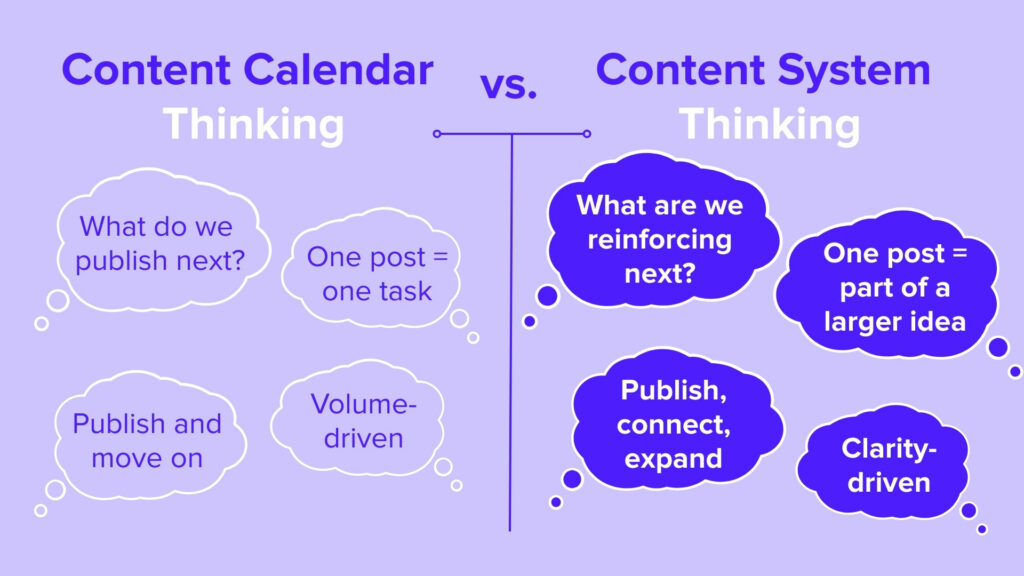
This shift doesn’t require more content, just better intention.
Here’s how to build a content system that reinforces the core ideas you want to rank in search for.
Organize around core ideas, not publishing dates
High-performing systems start with a small set of topics that matter deeply to the business. These are the ideas the brand wants to own — not just rank for once, but be associated with consistently.
Publishing cadence supports those ideas. It doesn’t replace them.
This is why two strong posts per month, when they’re part of a reinforced system, often outperform higher volume strategies. Each piece builds on what already exists.
Design content to reinforce itself
In effective systems, internal linking strategically strengthens old content with each new post.
Pages are written with awareness of what already exists and what will come next. Language is consistent. Definitions are reused and refined.
Over time, the site starts to feel like a rich library instead of a randomized feed.
Treat content as infrastructure
Content isn’t disposable. It’s a permanent asset that’s revisited, expanded, updated, and reused.
Distribution is part of the plan — through social, email, sales conversations, and internal enablement — because authority is built by exposure, repetition, and recognition.
This approach of treating content as infrastructure slows teams down just enough to compound results instead of fragmenting them.
How this connects back to SEO, GEO, and measurement
When content is planned as a system, measurement starts to make more sense.
Instead of asking whether a single post “worked,” teams can evaluate:
- whether visibility is expanding across related questions
- whether brand recognition is increasing
- whether demand shows up later through branded search, direct traffic, or assisted conversions
This framework is especially important in AI-assisted and generative environments.
Visibility doesn’t always produce an immediate click. Often it produces familiarity — which leads to return visits, brand searches, and better performance across other channels.
In that way, strong content systems turn SEO and GEO into multipliers, not standalone channels. They improve paid performance, shorten sales cycles, and reinforce trust long before attribution models catch up.
Discover how SEO improves ABM in generative search →
Systems outperform schedules
Content systems outperform calendars because they’re designed for how understanding is built — by people and by search systems alike. They value clarity over variety, coherence over speed, and reinforcement over novelty.
Calendars still play a role—we use them every day. But they’re not the strategy, they’re the schedule that supports the strategy.
When content is treated as infrastructure rather than output, SEO stops feeling fragile. Visibility expands naturally. And the work you do today continues to pay off long after the publish date.
Is your content calendar underperforming? We’d love to help you build a content system. Let’s talk →