



Summary:
SEO performance doesn’t usually collapse overnight. It slows gradually from execution debt—years of well-intended decisions that weaken clarity, structure, and trust. This post explains execution debt, how it usually forms, and what you can do to repair it.
Most SEO problems don’t show up right away. In fact, many websites that struggle today once performed well. Rankings improved. Traffic grew. Reports looked healthy. At some point, SEO felt “handled,” so attention moved elsewhere. Then something changed.
Growth flattened, visibility became inconsistent, and new content stopped moving the needle. Platform shifts surfaced weaknesses that no one anticipated. Teams often describe this moment as SEO “stopping,” when what’s really happening is quieter and more complex. What they’re experiencing is execution debt.
The problem no one notices until it’s too late
SEO rarely fails in a dramatic way. There’s no single breaking point, no obvious error message, no moment where everything suddenly collapses. Instead, performance degrades gradually.
Early signs are subtle and easy to rationalize. Traffic doesn’t disappear overnight, and rankings don’t fall off a cliff. What changes is momentum. Pages that once pulled their weight level off, while new content takes longer to gain traction. Everything slows down without a clear reason.
This is why execution debt is so risky: it doesn’t announce itself as a problem. It accumulates quietly while everything still appears functional, so by the time leadership feels the impact, the decisions that caused it may be years old.
Those old decisions are disconnected from current goals, current teams, and current expectations. Fixing the issue then means untangling years of accumulated decisions rather than making a simple adjustment.
What we mean by execution debt in SEO
Execution debt is the long-term cost of multiple SEO decisions that prioritize speed, volume, or short-term outcomes over clarity and reinforcement.
Most execution debt is created under reasonable constraints:
- aggressive timelines
- pressure to ship content
- limited resources
- shifting business priorities
The issue isn’t necessarily caused by bad intent or poor effort in what was decided at the time, but the effects of those short-term decisions compound over time.
Modern search—traditional and AI-assisted—relies on the same foundation:
- consistent understanding
- repeated explanation
- trust built over time
Execution debt undermines all three.
Learn how Google decides which brands it trust to explain a topic →
How execution debt differs from technical debt
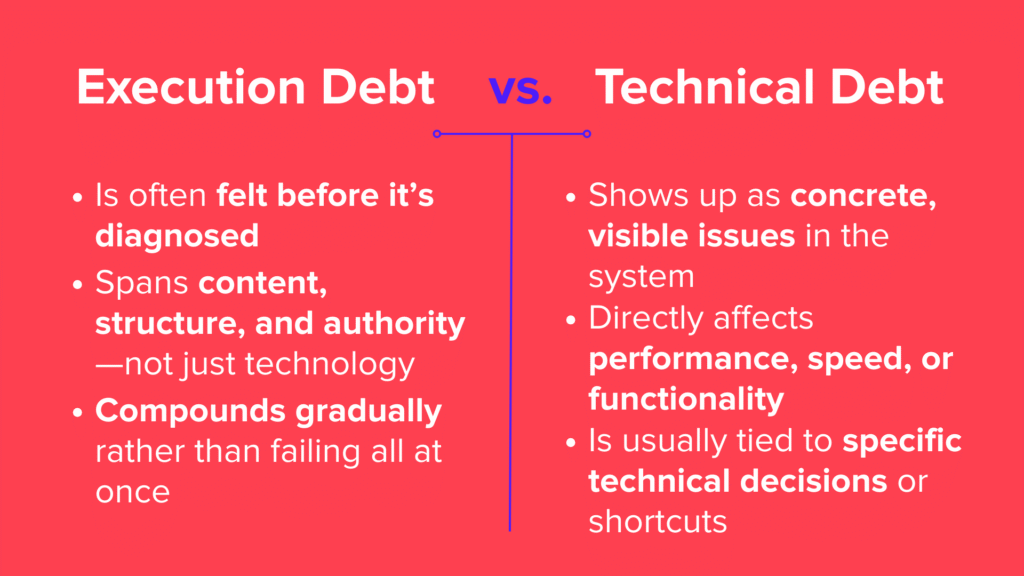
Technical debt usually refers to visible system issues—things that break or slow down performance directly. Execution debt is different than technical debt because it weakens the system without breaking it.
Technical debt:
- Shows up as concrete, visible issues in the system
- Directly affects performance, speed, or functionality
- Is usually tied to specific technical decisions or shortcuts
Execution debt:
- Is often felt before it’s diagnosed
- Spans content, structure, and authority—not just technology
- Compounds gradually rather than failing all at once
Everything still works. It just stops working as well as it should. That’s why execution debt is often misunderstood as “SEO not working anymore,” when in reality it’s SEO no longer compounding.
How execution debt actually forms
Execution debt doesn’t form because teams make bad decisions for the situation at hand; it forms because their decisions only apply to what’s happening in that moment. When a team needs content quickly, a campaign needs support, a keyword opportunity looks too good to ignore, or a quarterly goal needs to be hit, each SEO decision makes sense on its own.
The problem of execution debt stems from the cumulative effect of siloed, reactive SEO decisions, without proactive care for the foundation that holds it all up.
Here’s how many companies develop execution debt:
1. Early wins reward speed over structure
Early SEO work is often opportunistic. Teams publish content where demand exists and see results quickly because the space isn’t yet competitive. Rankings improve, traffic grows, confidence builds.
2. New work piles up while old work goes untouched
Now that there’s some clear SEO success, priorities shift. New initiatives emerge. New stakeholders get involved. The SEO work that already “worked” is left alone while new pages are layered on top. No one goes back to reinforce what’s already ranking. No one connects new content to old content in a meaningful way. No one steps back to ask whether the site still tells a coherent story.
This is the most important insight to understand: execution debt is usually created after success, not during failure.
3. Growth slows without a clear cause (AKA: execution debt)
By the time performance starts to flatten, nothing is obviously broken. There are simply too many disconnected decisions pulling the system in different directions, and the company is left wondering what went wrong and how to fix it.
Four primary sources of SEO execution debt
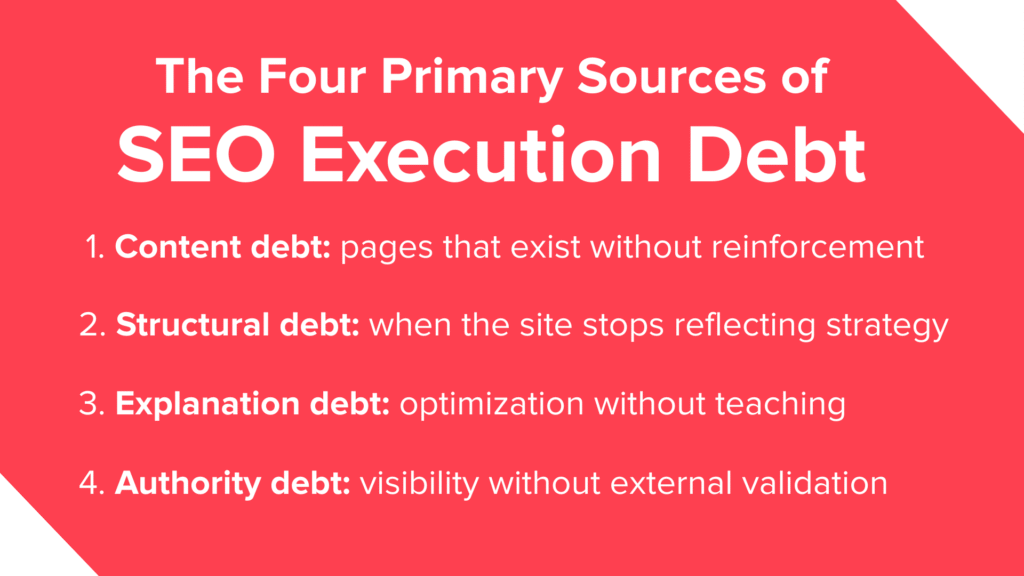
Execution debt most often comes from four patterns: content that isn’t reinforced, structure that no longer reflects strategy, explanations that assume understanding instead of building it, and authority that exists only on-site.
1. Content debt: pages that exist without reinforcement
A common pattern in early SEO on a site is one page per idea. A keyword is identified, the page is written, it ranks, and the team moves on.
Individually, these pages may be fine. Collectively, they don’t establish understanding. There’s no progression from basic to advanced concepts. No reinforcement across related topics and no signal that the brand owns an idea.
Strong sites revisit the same concepts repeatedly:
- from different angles
- for different audiences
- with increasing depth
This repetition isn’t duplication. It’s how expertise is demonstrated and learned—by both people and search systems.
Learn why content calendars are not a content strategy →
2. Structural debt: when the site stops reflecting strategy
Most websites grow reactively. New categories are added to support campaigns, pages are launched to meet immediate needs, and internal linking reflects recency rather than importance. Over time, structure begins to reflect organizational history instead of strategic intent.
Eventually, the site can no longer clearly answer:
- What are we known for?
- What topics matter most?
- How should new content fit into what already exists?
When everything is treated as equally important, nothing stands out.
Search engines rely heavily on structure to interpret priority and intent. When hierarchy disappears, clarity disappears with it—and expansion becomes difficult.
Learn how to build a content system →
3. Explanation debt: optimization without teaching
Explanation debt is one of the most subtle—and damaging—forms of execution debt.
In this pattern, content is optimized for search engines but written as if the reader already understands the subject. The writer skips definitions, doesn’t explain tradeoffs, and assumes the reader knows necessary context.
The page may rank, but it doesn’t teach a real audience.
This matters more now because AI-assisted search systems evaluate conceptual understanding, not just keyword alignment. When systems explore a topic through query expansion and synthesis, they favor sources that explain ideas clearly and consistently.
4. Authority debt: visibility without external validation
For a long time, strong on-site optimization was enough to perform well.
That’s no longer true.
Search systems increasingly rely on corroboration. Independent mentions, references, and recognition help confirm that a brand’s expertise extends beyond its own website.
When a site speaks only about itself, authority plateaus. When others reference it, trust compounds.
Authority today looks less like optimization and more like reputation.
Learn more about E-E-A-T and how it defines brand authority →
Why execution debt is exposed during platform shifts
Execution debt often remains hidden until systems change. Algorithm updates, AI-assisted summaries, new SERP layouts, and platform migrations don’t create problems—they reveal them.
When search engines place more emphasis on:
- topical coherence
- consistency across content
- trust and corroboration
…sites built on fragmented execution lose ground.
This is why teams often attribute performance drops to “the update,” when the real issue is accumulated fragility.
Learn more about common platform migration issues →
The hidden costs of execution debt
Execution debt doesn’t just affect rankings. It limits growth in less obvious ways.
Visibility ceilings:
Sites with execution debt can defend existing positions but struggle to expand into adjacent topics or higher-intent queries.
Learn more: Going beyond keywords with entity optimization →
Exclusion from AI and generative surfaces:
Fragmented sites are less likely to be synthesized or referenced. Systems prefer stable, reinforced explanations.
Learn more: What is Generative Engine Optimization →
Measurement confusion:
When SEO work doesn’t reinforce itself, attribution becomes muddy. Teams struggle to explain what’s working and why.
Learn more: Your SEO KPIs are broken →
Organizational drag:
As confidence erodes, teams compensate with more tools, more content, and more tactics—often increasing the debt they’re trying to escape.
How to identify execution debt in a mature organization
Execution debt leaves patterns behind. In mature organizations, those patterns show up as one-and-done coverage of core topics, flagship ideas treated as isolated pages, subtle inconsistencies across related content, and site structures that no longer communicate priority.
Core topics are covered once, not reinforced.
Flagship ideas exist as isolated pages instead of evolving bodies of content.
Related pages subtly disagree.
Different definitions, recommendations, or framing signal fragmentation.
Everything feels equally important.
Navigation and internal linking don’t clearly communicate priority.
Internal conversations feel fuzzy.
Teams struggle to articulate what the site is known for or what should come next.
Internally, execution debt often surfaces as uncertainty about what the site is known for or how future work should build on what already exists. The signal is a need for reinforcement across the system rather than wholesale change.
Paying down execution debt without starting over
The biggest misconception about execution debt is that fixing it requires tearing everything down.
In reality, the most effective approach is additive and connective.
Start with understanding, not cleanup.
Before deleting or consolidating, understand what the site already communicates. Identify the ideas worth owning long-term.
Reinforce before you replace.
Build depth around core concepts. Align language. Strengthen internal connections so content reinforces itself.
Shift from output thinking to system thinking.
Execution debt decreases when SEO decisions are made with compounding in mind. Each action should strengthen the whole, not just complete a task.
The goal isn’t perfection. It’s coherence.
A better mental model for SEO investment
SEO isn’t a campaign. It’s an asset. Like any asset, it can appreciate or decay. Execution quality determines which happens.
When SEO work is aligned, reinforced, and intentional, it compounds quietly. When it’s rushed or fragmented, execution debt builds—even if early results look strong.
Understanding execution debt isn’t about blame. It’s about making better decisions going forward.
For teams willing to do that work, SEO remains one of the most durable growth channels available.
Not sure if your “SEO stopped working?” Let’s talk →