


Summary:
SEO hasn't stopped working, but the way equity is built through it changed. Google now rewards brands it trusts to explain a topic clearly and consistently, not pages that rank once and fade. Visibility compounds through recognition and repetition, even when clicks lag. That’s where durable brand equity is being built now.
If SEO feels harder right now, you’re not imagining it. Search results look different. User behavior is less linear. Click-through rates are softer in places where rankings haven’t changed. And many teams are sensing that something fundamental has shifted—even if they can’t point to a single update or metric that explains it.
What’s important to say clearly is this: SEO didn’t suddenly stop working. What changed is how Google evaluates information, assembles answers, and decides which brands it’s willing to trust as sources. That shift affects where visibility shows up, how it compounds, and how success should be interpreted.
For teams willing to adjust how they think about SEO, this moment is more of a reset in how leverage is created than a loss of leverage altogether.
Why organic visibility feels different right now
For most of its history, Google functioned as a retrieval engine. You searched, Google ranked pages, and the real interpretation happened after the click. Today, more of that interpretation happens before a user ever lands on a site.
Google is increasingly trying to understand:
- what a person actually wants,
- what they’re likely to ask next, and
- whether a click is necessary to move them forward.
That doesn’t reduce the importance of websites, but it does raise the standard for which ones matter.
The result is a search experience where visibility is no longer confined to a single ranking position. It’s distributed across Google’s summaries, references, follow-up prompts, and brand recognition over time.
AI Overviews: The first visible shift
AI Overviews were the first place where many teams felt this change. Answers appeared at the top of the page. Information was synthesized. In many cases, users got enough context without clicking through.
It’s easy to treat AI Overviews as the disruption to the SERP that robs clicks. Strategically, they’re better understood as Google testing when it feels confident enough to explain something itself.
AI Overviews tend to appear when:
- the intent behind a query is clear,
- the topic is relatively stable, and
- Google believes it can rely on a consistent set of sources.
That last point matters most. AI Overviews are less about automation and more about confidence. They show up when Google believes it understands both the topic and who should be trusted to represent it. That confidence is what makes the next step possible.
From AI Overviews to AI Mode: A logical progression
AI Mode didn’t come out of nowhere. It’s the natural extension of what AI Overviews began. Where AI Overviews attempt to answer a question, AI Mode supports exploration. Instead of treating each search as isolated, Google treats it as part of a session.
That means:
- follow-up questions are expected,
- context carries forward, and
- understanding is built over several interactions.
This mirrors how people actually learn. We don’t ask one perfect question. When we receive answers that don’t quite satisfy our need or curiosity, we refine, adjust, and probe until something clicks. AI Overviews proved Google could summarize confidently. AI Mode applies that confidence across an entire journey.
How Google’s AI Mode differs from LLMs (and why that difference matters)
It’s tempting to equate Google’s AI features with large language models, but the distinction is important.
LLMs are built to generate language by synthesizing patterns from training data and producing coherent explanations. They’re excellent at helping people explore ideas. Google, on the other hand, still operates as a search engine first.
That means it must:
- rely on indexed, attributable sources,
- evaluate credibility and consistency, and
- decide which brands are reliable enough to surface publicly.
Google isn’t trying to replace search with a chatbot. It’s layering conversational behavior on top of a system that still depends on trust signals (think E-E-A-T). That’s why traditional SEO inputs still matter—but only when they reinforce your credibility and Google’s understanding of your industry.
Query Fan-Out: How Google’s AI Mode explores a topic
One of the most important shifts happening quietly is how Google interprets a single query. When someone searches using AI Mode, Google expands the question.
This process, often called query fan-out, explores:
- common follow-up questions,
- related risks or considerations, and
- adjacent concepts people usually need to understand.
For example, a search for “cold plunge benefits” rarely stands alone. Google implicitly explores recovery, inflammation, safety, frequency, and evidence. It then evaluates which sources address those ideas consistently and accurately, and includes them in the list of citations and recommended websites.
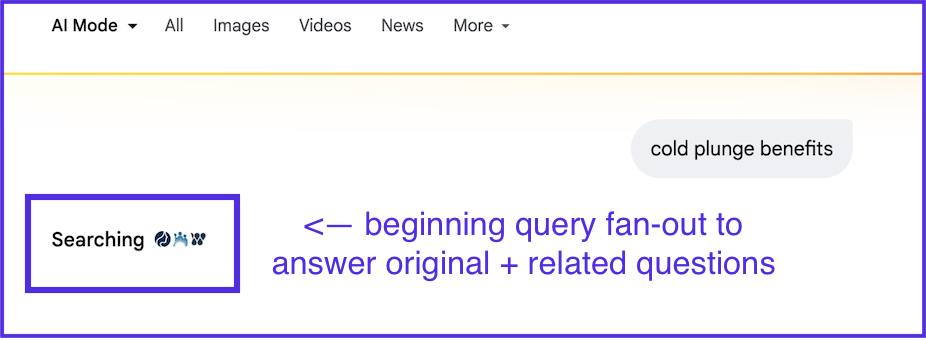
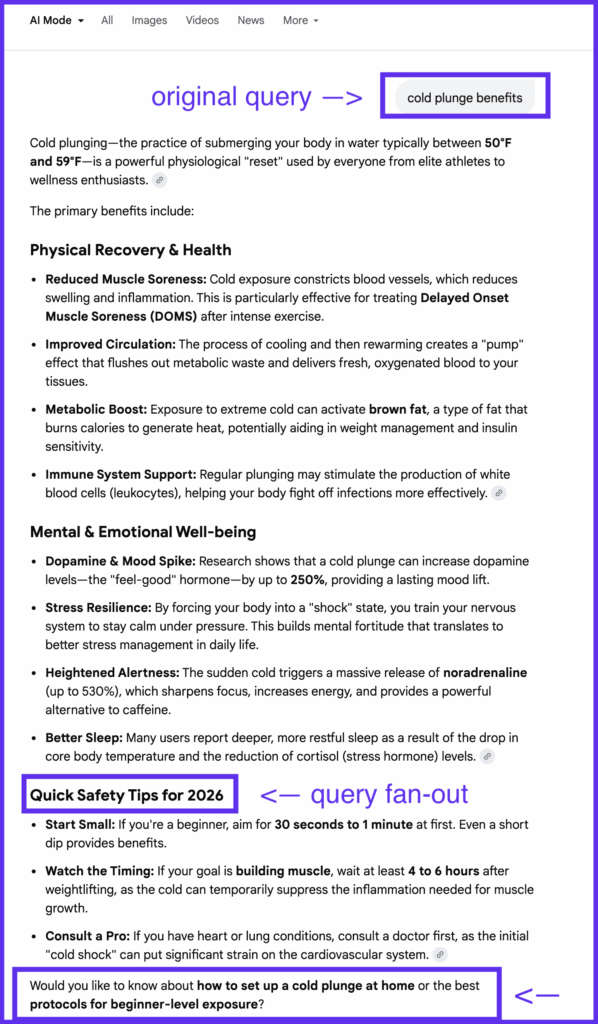
Google’s preference for comprehensive topical coverage is why narrowly optimized pages struggle. They answer one phrasing well but don’t support the broader concept.
Content that performs best tends to:
- revisit the same ideas from multiple angles,
- explain tradeoffs and nuance, and
- remain consistent across pages.
Thorough and consistent content gives Google confidence that a brand actually understands the topic.
What AI changed in how Google surfaces brands
When you strip away the AI interfaces themselves, the shift is straightforward.
From pages to concepts
Individual pages still matter, but they can’t be one-trick ponies for the site.
Google evaluates whether a brand has demonstrated understanding across a topic, not whether it published a single relevant page that happens to rank.
Brands that surface consistently tend to reinforce the same ideas across multiple pieces of content, using stable language and clear definitions.
From keywords to context
Keywords still matter, but context determines meaning.
Search systems now look for:
- alignment across related pages,
- consistency in how ideas are framed, and
- signals that a topic is understood beyond surface-level coverage.
This is why content written to teach tends to outperform content written purely to capture demand.
From ranking pages to trusting sources
Because Google is increasingly selective about which brands it allows to explain a topic in AI Mode, ranking is no longer the final filter. Instead, trust is earned through repetition, corroboration, and clarity over time.
This is where Digital PR, brand mentions, and the authority layer comes in.
Google does not rely solely on what a brand says about itself. Independent mentions act as confirmation. When your brand is referenced consistently in relevant contexts—articles, interviews, research, industry commentary—it reinforces credibility beyond your website.
SEO and digital PR can’t be treated as separate efforts anymore. Recognition builds trust, and trust influences visibility across AI-assisted systems.
Authority today looks less like optimization and more like reputation.
Why some brands lost visibility — and others didn’t
Contrary to what you might expect, the size of your company alone is less relevant to your visibility than the trust that Google has in your content strategy.
Brands that struggled the most with Google’s shift to AI interfaces were creating content in isolation—one page per keyword, minimal reinforcement, little accumulation of expertise.
By contrast, brands that continue to surface tend to revisit the same core ideas, explain them plainly, and build depth intentionally. Their content sounds like it comes from a single, confident point of view that understands the subject matter through professional and/or personal experience.
That coherence makes Google’s job easier. When the coherence is missing, it moves on to what it can interpret and trust.
Learn more about entity optimization and why you need to think beyond keywords →
What to measure now that visibility doesn’t equal clicks
When teams realize that visibility now shows up in more places than a single organic session, the next question is inevitable:
If clicks don’t tell the full story, how do we measure whether this is actually working?
The answer is to expand your dashboard of results and to be honest about what can be measured precisely versus directionally.
There is no single metric that replaces organic traffic. But there is a clear set of signals that, taken together, tell you whether SEO and GEO are doing their job.
1. Directional presence on the questions that matter
In AI-assisted search, visibility is not binary. You’re not simply “ranking” or “not ranking.”
The more important question becomes: Are we showing up when our audience asks the questions that define our category?
This is where directional tracking matters.
Rather than relying on a fixed keyword list, we look at:
- Core questions buyers actually ask
- Variations and follow-ups that appear across AI-assisted results
- Whether a brand is referenced, cited, or implied in answers over time
Look for trend and consistency. If you’re increasingly present across the questions that shape understanding in your space, that visibility compounds whether or not it registers as a click.
2. Share of voice (without pretending we control the SERP)
Traditional share-of-voice models assume a stable set of keywords and results. That assumption no longer holds.
Query fan-out, conversational refinement, and AI synthesis mean:
- The query set is fluid
- The result set adapts in real time
- You don’t control the full universe of questions
So instead of trying to “own” a static keyword list, we look at:
- Coverage across core topic areas
- Frequency of brand appearance relative to peers
- Whether your brand is being pulled into broader explanations, not just narrow answers
This is share of voice at the concept level. It’s less tidy than keywords, but far more aligned with how search actually works now.
3. Discovery signals that show up later
One of the most important shifts teams need to internalize is this: Discovery and conversion are increasingly decoupled in time.
A user may:
- Encounter your brand in an AI-generated answer,
- See your name referenced repeatedly across searches, and
- Come back days or weeks later through a completely different channel
That means measurement has to account for lag.
Two signals matter here:
Referral traffic
- Mentions, citations, and coverage driving awareness
- Often inconsistent, but meaningful when it spikes around content or PR moments
Brand search demand
- Increases in branded queries
- Growth in brand-modified searches
- Rising direct or branded organic traffic over time
When these rise alongside expanded topical visibility, it’s a strong signal that SEO/GEO is doing its job.
4. SEO as a multiplier, not a standalone channel
This factor is where many teams get tripped up. They evaluate SEO in isolation, then wonder why the numbers feel soft. In reality, modern SEO and GEO increasingly function as force multipliers.
Strong organic visibility tends to:
- Improve paid search performance through higher brand recognition
- Increase click-through rates on ads because users recognize the brand
- Shorten sales cycles by pre-educating buyers
- Raise conversion rates across channels, not just organic
In other words, SEO doesn’t just generate traffic. It changes how every other channel performs.
When you see:
- Paid campaigns converting more efficiently
- Branded demand increasing
- Content being referenced in sales conversations
…that’s SEO working beyond the click.
5. What this means for measurement expectations
None of this means measurement becomes fuzzy or subjective. It means measurement becomes multi-dimensional.
You still track: organic traffic, rankings where they’re meaningful, and conversions and revenue.
But you also layer in: directional visibility across key questions, brand demand growth, and assisted performance across channels.
This method of measurement shows exactly where SEO, GEO, and the C.L.A.R.I.T.Y. framework intersect.
Learn more: Your SEO KPIs Are Broken →
The C.L.A.R.I.T.Y. framework for visibility
These shifts in Google are why we approach SEO as a system rather than a checklist.
- Crawl — Your expertise has to be accessible and interpretable.
- Learn — You need to understand how your brand is currently perceived.
- Analyze — Identify gaps in coverage, clarity, and trust.
- Respond — Create content that explains real questions thoroughly.
- Integrate — Align content, PR, and brand signals.
- Train — Reinforce ideas through consistency over time.
- Yield — Let visibility compound where decisions are formed.
Our goal is to ensure that when inevitable SERP changes happen, your brand still fits naturally into the way Google understands the topic.
Learn more about tiptop’s C.L.A.R.I.T.Y. AI optimization framework →
What winning SEO looks like going forward
Google is becoming more selective about what it’s willing to trust and surface. Brands that invest in clarity, credibility, and consistency will continue to earn visibility regardless of how results are displayed.
The teams that navigate this shift thoughtfully won’t chase every new feature. They’ll build strategies that compounds by publishing more useful content, focusing on fewer topics, explaining them clearly, and reinforcing them consistently across channels. They’ll treat SEO as infrastructure—something that supports growth even as presentation layers change.
Need a strategy built for SEO and GEO? Let’s talk →